

What’s the Difference Between Ancestry DNA Testing and Carrier Screening?

.webp)
Summary
Recreational DNA kits are for curiosity; clinical screening is for healthcare.
- Accuracy: Clinical tests (like jscreen) use Full Gene Sequencing for 99%+ accuracy, while ancestry kits often only scan "hotspots" (SNPs).
- Standards: Clinical labs must meet strict CLIA/CAP federal standards for medical diagnosis; ancestry labs do not.
- Risk: Up to 40% of medical variants found in "raw data" from consumer kits are false positives.
- Support: Clinical testing includes telehealth genetic counseling to turn data into a medical action plan.
“I don’t need any more genetic testing – I had that one ancestry test and I’m pretty sure they tested me for everything I need.”
Unfortunately, this is a dangerous misconception. In 2026, the gap between ancestry DNA tests and clinical-grade genetic screening has only grown wider. While ancestry tests are great for finding long-lost relatives, they are not a medical tool, and it’s very possible the ancestry test didn’t include as much genetic testing as you might have thought.
There are major differences between the various types of genetic tests a person may get. Here are some key things to know:
1. There are many ways to test a person’s DNA.
Testing companies, like ancestry.com and 23andMe, are not required to meet the higher standards and certifications that clinical laboratories must meet. They are not held to the same CLIA (Clinical Laboratory Improvement Amendments) or CAP (College of American Pathologists) standards required for medical diagnosis. On the other hand, jscreen, as well as doctors’ offices, do testing through clinical laboratories, so they provide a validated, trustworthy result.
What Makes the jscreen At-Home Genetic Testing Kit Different?
While jscreen does offer the convenience of a "home kit," it’s important to clarify that it isn't the same as a recreational ancestry kit. jscreen is a clinical-grade medical service delivered in a consumer-friendly way. Think of it like this: an ancestry kit is for curiosity, while jscreen is for healthcare planning.
Even though both arrive in the mail and use a saliva sample, the technology and oversight behind jscreen and other consumer tests is fundamentally different:
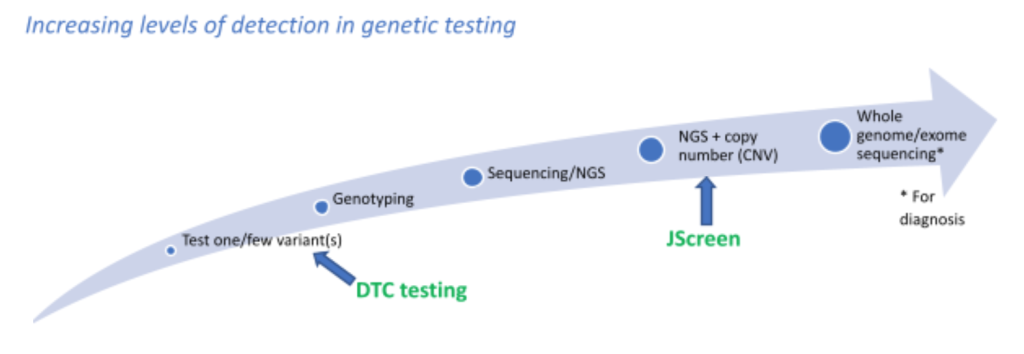
Here’s a quick guide to how features stack up between Clinical Grade and Direct-to-Consumer tests:
- Technology
- Direct-to-Consumer (like Ancestry): Often use SNP (Single Nucleotide Polymorphism) technology, which only scans for common "hotspots" or markers. It's like reading a few random pages of a book.
- Clinical Grade (like jscreen): Uses Next-Generation Sequencing (NGS) and Copy Number Analysis (CNV) to read the entire "instruction manual" of a gene. This identifies rare but critical mutations that consumer tests miss.
- Oversight
- Direct-to-Consumer: No doctor required
- Clinical Grade: Physician-ordered and reviewed
- Accuracy
- Direct-to-Consumer: Varies; potential for false positives
- Clinical Grade: CLIA-certified lab results (>99% accuracy)
- Follow Up
- Direct-to-Consumer: Most often, you’re on your own
- Clinical Grade: Telehealth genetic counseling included
It’s important to note that even within clinical testing, there can be stark differences in the capabilities of various tests that may be ordered. You may wish to speak to a genetic counselor to help you confirm that the test you’re getting is of clinical quality, comprehensive (covering a number of different genes), with a high capability of picking up a genetic mutation (if one is present), and a low rate of false positives or false negatives.
Direct-to-consumer (DTC) testing companies, like ancestry.com and 23andMe, are not required to meet the higher standards and certifications that clinical laboratories must meet. jscreen, as well as doctor’s offices, do testing through clinical laboratories, so they provide a validated, trustworthy result.
But, even within clinical testing, there can be stark differences in the capabilities of various tests that may be ordered. You may wish to speak to a genetic counselor to help you determine whether the test you’re getting is of clinical quality, comprehensive (covering a number of different genes), with a high capability of picking up a genetic mutation (if one is present) and a low rate of false positives or false negatives.
2. The Risk of "Raw Data" and False Positives
According to the NIH and researchers at the Mayo Clinic, up to 40% of "variants" found in the raw data of DTC kits were actually false positives when retested in a clinical lab.
Given these finding, any test result from a DTC company should be confirmed through a clinical lab.
[Medical Warning]: Never undergo surgery or change medical management based on a DTC report alone. There have been documented cases of patients undergoing irreversible procedures based on inaccurate results. Clinical labs like those used by jscreen provide validated, trustworthy results and genetic counseling that you and your doctor can actually use.
3. Choosing the Right Test for Your Intent
There are different reasons why a person may want genetic testing. As a result, different tests are the right choice for different people.
Here are some common options:
a. Planning a family:
If you want to know your chance of having a child with a genetic condition, you probably want reproductive carrier screening through a clinical lab (jscreen, or your doctor’s office). Ideally, you would test prior to getting pregnant and using a comprehensive panel including up to hundreds of conditions. DTC companies often test a small number of genes with lower detection rates, so they are typically not the ideal choice for this type of testing.
b. Interest in cancer risk:
If you want to know the chance that you may develop cancer in the future, you probably want cancer genetic screening through a clinical lab. Again, a comprehensive panel is often ideal. Keep in mind, though, that genetic testing only looks for the inherited risks for cancer – everyone also has a general population risk, since most cancers happen sporadically. So, regardless of your genetic test results, you should still do cancer screening (mammograms, prostate exams, etc) recommended by your doctor.
c. Genealogy/Heritage
Maybe you want to know more about your ancestry, or try to connect with lost relatives. DTC testing may be the right choice for you.
d. New Symptoms
If you want help diagnosing a condition, you likely need a visit with a specialist (such as a geneticist). They can assess your symptoms and help in your diagnosis, and a genetic counselor can review appropriate specialized genetic testing options with you.
Here’s an easy-to-read quick guide:
Goal: Family Planning
Recommended Test Type: Expanded Carrier Screening (ECS)
Why?: Only clinical panels (like jscreen) cover 200+ conditions like Tay-Sachs and CF with 99%+ accuracy.
Goal: Cancer Prevention
Recommended Test Type: Hereditary Cancer Panel
Why? Focuses on 60+ genes (BRCA, Lynch Syndrome) with clinical follow-up.
Goal: Genealogy/Heritage
Recommended Test Type: Ancestry DNA (DTC)
Why? Best for tracing ethnicity and finding distant relatives.
Goal: Addressing New Symptoms
Recommended Test Type: Clinical Diagnostic Testing
Why? Requires a specialist (Geneticist) to diagnose a specific active condition.
4. Why You Need a Genetic Counselor
One of the biggest differences between jscreen and other kits is the human element. Genetic counselors are trained professionals who bridge the gap between "data" and "life."
At jscreen, you aren't just getting a PDF; you are getting a personalized telehealth consultation. Counselors help you:
- Navigate the emotional impact of a positive result.
- Understand the 25% risk factor for recessive conditions if both parents are carriers.
- Develop a concrete medical "Action Plan" for your family.
Take the Next Step Toward a Healthy Future
While ancestry tests provide a fascinating look at the past, clinical carrier screening is about protecting your future. Don't let a "recreational" DNA test be the only information you rely on for your family's health. By choosing a physician-reviewed, clinical-grade kit, you aren't just getting data—you’re getting a roadmap.
Your DNA is a lifelong blueprint. Make sure you’re reading the right version. Order your Reproductive Carrier Screening and/or Hereditary Cancer Testing Kit today, and have peace of mind that jscreen will be here to guide you through the process from start to finish.
References:
- Tandy-Connor, S., et al. (2018). False-positive results released by direct-to-consumer genetic tests highlight the importance of clinical confirmation testing for appropriate patient care. Genetics in Medicine, 20(12), 1515-1521. https://doi.org/10.1038/gim.2018.38
- Centers for Medicare & Medicaid Services (CMS). (2024). Clinical Laboratory Improvement Amendments (CLIA). Retrieved from https://www.cms.gov/regulations-and-guidance/legislation/clia
- American College of Obstetricians and Gynecologists (ACOG). (2023). Carrier Screening for Genetic Conditions. Committee Opinion No. 691. Retrieved from https://www.acog.org/clinical/clinical-guidance/committee-opinion/articles/2017/03/carrier-screening-for-genetic-conditions
- Gregg, A.R., et al. (2021). Screening for autosomal recessive and X-linked conditions during pregnancy and preconception: a practice resource of the American College of Medical Genetics and Genomics (ACMG). Genetics in Medicine, 23(10), 1793-1806. https://doi.org/10.1038/s41436-021-01203-z
- National Society of Genetic Counselors. (2024). Genetic Counseling FAQs. Retrieved from https://www.nsgc.org/About/About-Genetic-Counselors/Genetic-Counseling-FAQs
U.S. Food and Drug Administration (FDA). (2023). Direct-to-Consumer Tests. Retrieved from https://www.fda.gov/medical-devices/in-vitro-diagnostics/direct-consumer-tests
Share this post


